
Client Profile: A medical diagnostics company specializing in high-throughput liquid chromatography and automated optical analysis systems.
Application: High-precision UV-Visible (UV-Vis) absorption spectroscopy for quantifying biomolecules in low-volume liquid streams.
The Challenge: Dimensional Instability and Signal Noise
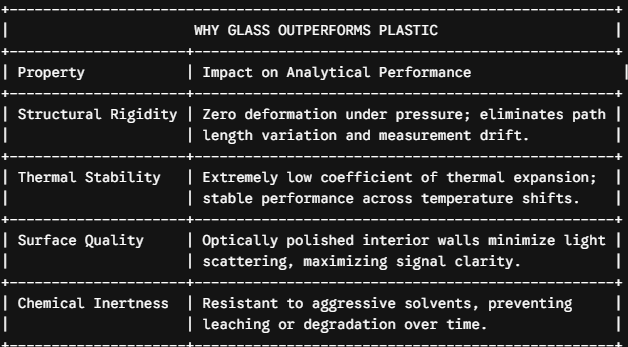 The engineering team initially designed their fluidic pathway using a specialized high-performance fluoropolymer plastic tubing loop to channel the sample fluid through the optical path. While plastic offered low upfront costs and ease of prototyping, it introduced severe inconsistencies during validation testing.
The core issue was structural and optical instability:
- Micro-Deformations: Under routine system pressure fluctuations and ambient temperature shifts, the plastic tubing subtly expanded and contracted. This altered the path length (the exact distance the light travels through the sample). Because concentration calculations rely on a fixed path length, these micro-deformations caused noticeable measurement drift.
- Material “Creep”: Over extended use, the plastic suffered from structural creep, permanently altering its cross-sectional geometry and compromising long-term data reproducibility.
- Surface Scattering: The internal surface of the extruded plastic possessed micro-striations that scattered light, reducing the signal-to-noise ratio.
The Solution: Custom Engineered Glass Flow Cells
To resolve these critical errors, the company partnered with Specialty Glass Products (SGP) to replace the flexible plastic setup with a rigid, custom-fabricated borosilicate glass flow cell, tailored exactly to their instruments’ dimensional envelopes.
Borosilicate glass was chosen for its outstanding optical clarity and mechanical rigidity. SGP precision-machined the internal channels to a strict tolerance, ensuring a perfectly fixed optical path length down to the micron.
The Results
By switching from unstable plastic tubing to SGP’s custom glass flow cells, the medical diagnostics firm achieved a 95% reduction in baseline signal drift. The absolute rigidity of the glass guaranteed that the path length remained completely static, allowing the instrument to meet its strict reproducibility benchmarks for regulatory approval. Additionally, the superior surface finish of the glass optimized light throughput, significantly improving the system’s lower limit of detection.
Want to learn more about switching from plastic to glass? Contact our team of glass specialists today!